
The Problem with Head Transplants and Doctor Robert White
If the brain is the seat of the soul, what happens to the self when you change the body?

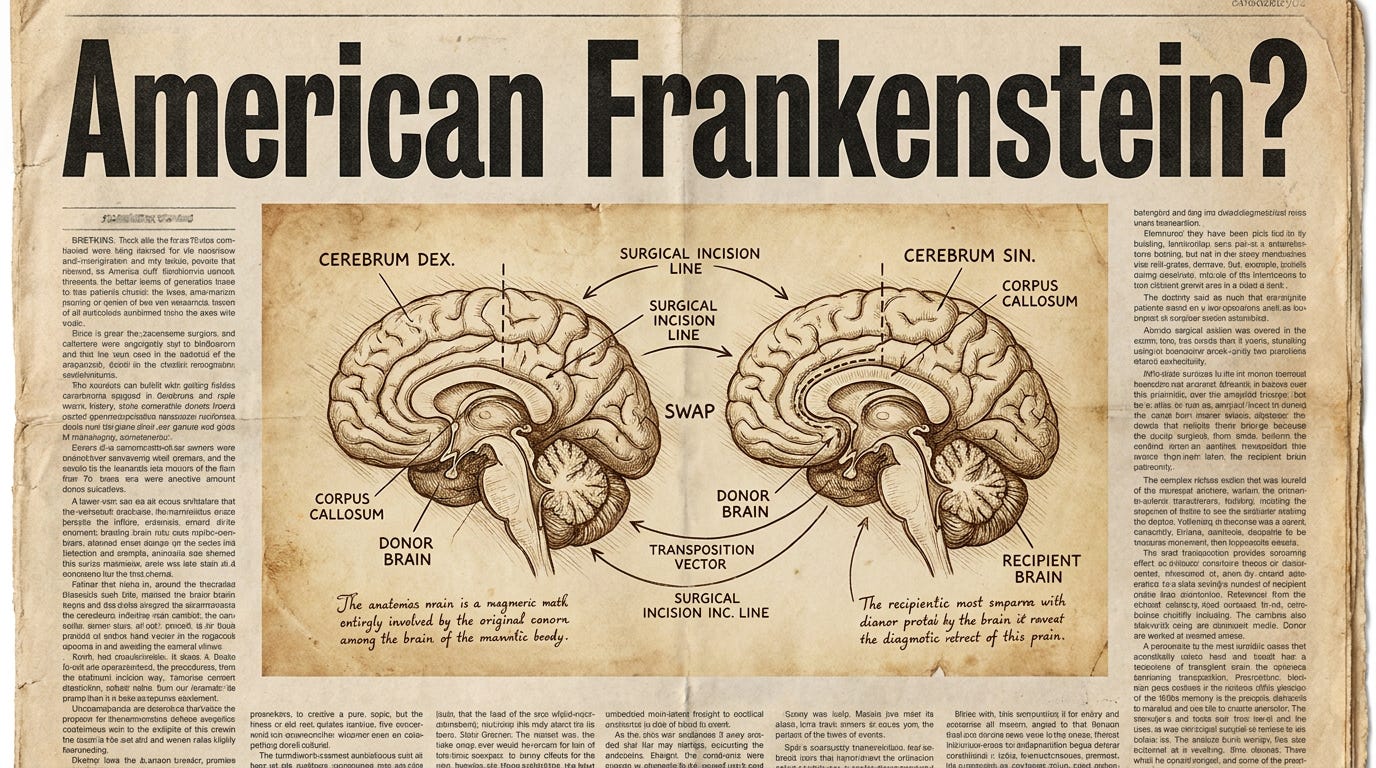
In 1970, a rhesus monkey woke up in a Cleveland laboratory and did something extraordinary: it tried to bite its doctor.
Usually, a bite is a bad sign in a hospital. But for Dr. Robert White and his team, it was a triumph. They had just performed the world’s first successful primate head transplant. The monkey was paralyzed from the neck down, but its mind was clearly there. It could see, hear, and smell. Most importantly, it was conscious.
I’ve been thinking about this story a lot lately because it feels like the perfect, messy intersection of neuroscience and philosophy. Most of that curiosity was sparked by Brandy Schillace’s excellent book, Mr. Humble and Dr. Butcher. It’s one of those rare books that stays with you after you’ve finished it. The story it tells isn’t really about surgery. It’s about identity, death, and how far a person should go in pursuit of an answer.
Robert White was a man of some pretty startling contradictions. He was a Harvard-trained neurosurgeon who performed over 10,000 operations, but he was also a devout Catholic who attended Mass every day and raised ten children. To his colleagues, he was “Humble Bob.” To the activists picketing his home, he was “Dr. Butcher.” White seemed to understand the tension. He even appeared on television with a medical bag labeled “Dr. Frankenstein.”
Maybe he knew that what he was doing wasn’t just surgery. Instead he was trespassing into territory that medicine couldn’t fully explain.
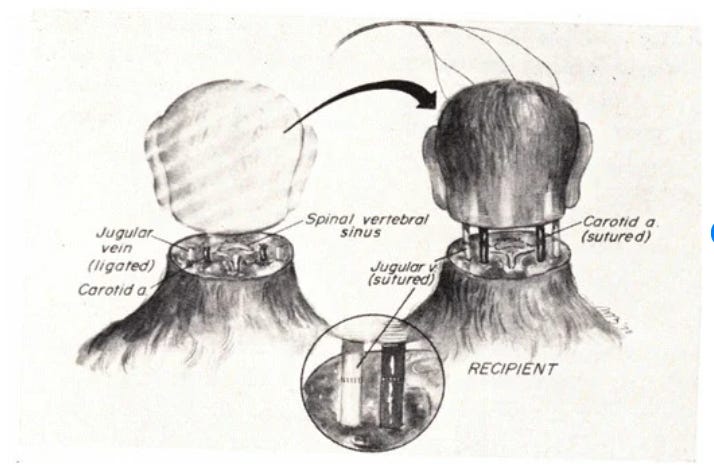
His work didn’t happen in a vacuum. It was fueled in part by the Cold War “inner space race.” In the late 1950s, strange footage emerged from the Soviet Union showing Vladimir Demikhov’s experiments, including dogs with surgically attached secondary heads that appeared capable of responding to the world around them.
While those experiments were often dismissed as grotesque curiosities, they convinced White of something radical. In his own research, he explored whether a brain could remain alive and functional when supplied with blood outside its original body. Over time, he became convinced that the brain was fundamentally different from every other organ. He referred to it as the “physical repository of the human soul.”
That’s the part I keep getting stuck on.
Not because it’s obviously wrong. In some ways, modern neuroscience has spent decades moving closer to the idea that the brain is the primary seat of memory, personality, consciousness, and identity. If those things make us who we are, then what exactly is the rest of us?
White’s answer was surprisingly straightforward. He saw the body as secondary. If the brain could survive, perhaps the person could survive too.
This wasn’t just a philosophical exercise for White. Throughout his career, he treated patients whose minds remained intact while their bodies failed around them. People living with severe paralysis, terminal illness, and neurological injuries forced him to confront a difficult question: what happens when the person’s mind is still there, but the body can no longer support them? White believed a whole-body transplant might one day offer an answer. In his view, preserving a functioning brain meant preserving the individual.
The more I read about White, the harder it became to dismiss him as someone simply chasing a medical stunt. He wasn’t talking about immortality. He wasn’t trying to create a science-fiction future. At least by his own account, he was thinking about patients. People trapped inside bodies that no longer cooperated. People that medicine could keep alive, but not necessarily help. A head transplant wasn’t supposed to be a spectacle. It was White’s attempt to answer a question that still feels surprisingly relevant today: if the mind remains intact, why should the body get the final say?
But once you start asking that question, it doesn’t stay confined to medicine for very long.
White’s work kept leading him toward a much older problem: what exactly is death? Not biological failure in a general sense, but the specific moment a person ceases to exist. If a heart can be restarted, if lungs can be replaced by machines, and if a brain can remain alive while the body deteriorates, where should the line be drawn? More importantly, who gets to draw it?
Those questions eventually brought him to the Vatican. As a consultant to the Pope’s Commission on Bioethics, White became involved in discussions surrounding the emerging concept of brain death. At the time, medicine was moving away from defining death solely by the stopping of the heart and toward a neurological definition centered on the irreversible loss of brain function. For White, this wasn’t just an academic debate. If the brain was truly the seat of identity, then preserving the brain meant preserving the person.
The question was significant enough that it reached Pope John Paul II. White argued that a whole-body transplant would not constitute murder because the individual would remain attached to the living brain. In his view, the operation was not taking a life but preserving one. The discussions between White and the Vatican ultimately found common ground on a crucial point: if the brain is the primary locus of who we are, then brain death can be understood as true death. That agreement helped shape broader conversations about organ transplantation, end-of-life care, and the ethical limits of modern medicine.
Still, the fact that White found himself discussing head transplants with the Pope says something about the nature of the problem. This was no longer a question of surgical technique. It had become a question about the soul.
But this is where admiration for White often collides with discomfort.
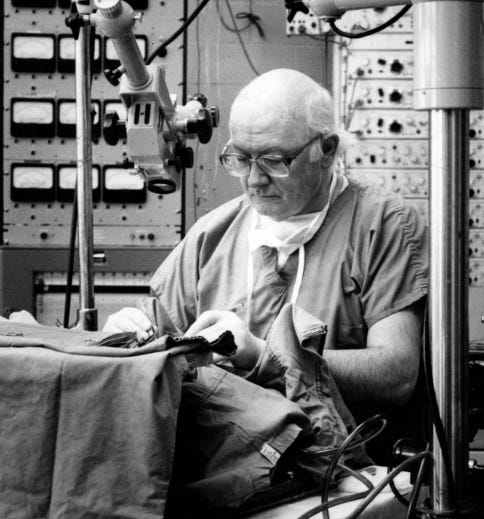
While many of White’s cooling techniques and surgical innovations remain valuable today, his transplant experiments are frequently described as existing at the edge of acceptable science. Bioethicist Arthur Caplan called the pursuit “rotten scientifically and lousy ethically.” The European Association of Neurosurgical Societies has also condemned the idea of human head transplantation on ethical grounds.
The most unsettling criticism, however, came from people who witnessed the experiments firsthand.
Neurologist Jerry Silver, who worked alongside White during the famous monkey transplant, later described the scene as horrific. He recalled an animal that appeared frightened, confused, and in distress after regaining consciousness. The monkey could see and react to the world, but it remained trapped within a body it could not control.
It’s a disturbing image.
But what makes it disturbing?
Is it the suffering itself? The idea of treating consciousness as a technical problem? Or is it something deeper?
The debate often centers on a concept known as embodied cognition. Modern cognitive science increasingly suggests that our minds are not isolated computers sitting inside our skulls. Our sense of self may emerge from a constant dialogue between brain, body, and environment.
If that’s true, then White’s assumptions may have been fundamentally flawed.
Or perhaps they were incomplete.
A transplanted brain might retain memories, language, and personality. But would it still feel like the same person? Would consciousness survive the transition intact? Or would something essential be lost in the process?
The uncomfortable truth is that nobody really knows. These were not observations that could be made using a Rhesus monkey. The patient would have to be human.
White died in 2010 before he could attempt his proposed “White Operation” on a human being. Yet his questions refuse to die with him. Even today, surgeons periodically claim that human head transplantation is technically achievable, often relying on principles and methods White helped pioneer decades ago.
So how should we remember Robert White?
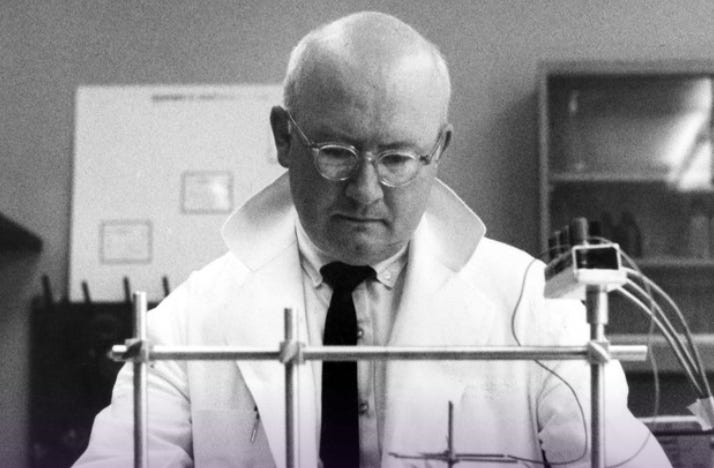
Was he a visionary who recognized the importance of the brain before much of medicine caught up? Was he an American Frankenstein whose ambition outran his ethics? Was he a devout man trying to preserve human life, or a surgeon who reduced people to little more than their nervous systems?
Maybe the most interesting possibility is that he was some combination of all of those things.
What keeps pulling me back to this story isn’t whether White was right or wrong. It’s the question sitting underneath all of it.
If the brain truly is the seat of the self, why does the idea of moving into another body, even for the sake of survival, feel so unsettling?
I pose many questions in this article, because this was not the sort of article I felt comfortable drawing hard conclusions. There still too much to understand, I’d love to hear what others think.
Sources
Beck, D. (2018). The ethics of human head transplants explored: Part two. The Prindle Institute for Ethics.
Čartolovni, A., & Spagnolo, A. G. (2015). Ethical considerations regarding head transplantation. Surgical Neurology International, 6, 103.
Engebretson, K. (n.d.). The seminal and sometimes weird science of Dr. Robert White. University of St. Thomas Newsroom.
Gkasdaris, G., & Birbilis, T. (2019). First human head transplantation: Surgically challenging, ethically controversial and historically tempting – an experimental endeavor or a scientific landmark? Maedica (Bucur), 14(1), 5–11.
Hudson, A. (2019). Trans-somatic transplant: Furthering health disparities in transplant surgery. The Mudd Journal of Ethics, 4, 14–22.
Mirkes, R. (2018). Human head transplants: Why it’s time for a serious debate. Ethics & Medicine, 34(3), 163–168.
Schillace, B. (2021). Mr. Humble and Dr. Butcher: A Monkey’s Head, the Pope’s Neuroscientist, and the Quest to Transplant the Soul. Simon & Schuster.
Scene Staff. (1999). The Frankenstein factor. Cleveland Scene.
Sheposh, R. (2024). Head transplant. EBSCO Research Starters.
Hopefully I can add something positive from the White clan?